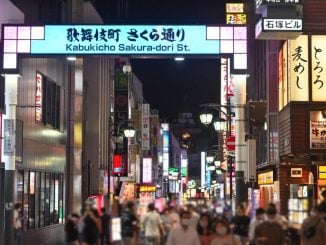

Coffee Shop Cool sits in the Marutomo Building, a short walk from Seibu-Shinjuku Station. The signs are faded and easy to miss under the giant Daikoku drugstore glow downstairs. If you don’t already know it’s there, you walk past it.
Inside it’s a classic old-school kissa: coffee, pudding, omurice, naporitan, smoking allowed, about 40 seats. Lunch sets run around 900 yen. Iced coffee is about 500. For prime Kabukicho real estate in 2026, that’s almost rude.
The hours are the real flex. Weekdays it only shuts from 7 to 8 in the morning. Friday and Saturday it just stays open. So you get the after-club crowd, the before-club crowd, the people who never went home, and the people who treat it like an office.
And the mix is wild. Regulars have talked about seeing company bosses, hosts killing time with fans, students, Toyoko kids, women between papakatsu dates, sex-industry interviews at the next table, and yakuza types talking business. One story that keeps getting retold: a gang member tried to do yubitsume — cut off his own finger as an apology — right there in the shop. A manager stopped him.

A guy who’s been coming for 20 years calls it an ibasho, a place you belong. A farmer who used to drop in every week called the whole scene “the liberal wind of Shinjuku.” That’s a polite way of saying this is where Kabukicho’s leftovers and lifers all sit under the same fluorescent lights.
Cool wasn’t born independent. It started as a Tomorrow chain shop that was losing money. In the 1980s the first master bought it out and renamed it. Since then it’s survived Ishihara’s early-2000s “clean up Kabukicho” push, the 2008 death of the Shinjuku Koma Theater, a pile of cinema closures, and the usual kissaten die-off that took out so many Showa coffee shops when Starbucks and Doutor showed up.
The original owner died in 2024. Floor manager Shimada Masayuki, who’s been there since 2014, now runs it in full “Showa dad” mode. There are no employee manuals. No written recipes. Curry tastes different depending on who cooked it that day. They even stayed open through COVID because the subsidies weren’t worth shutting the lights off.
Tokyo keeps getting smoother and more corporate. Golden Gai fights developers. Kabukicho Tower sits there looking like a department store that wandered into the red-light district. Cool is the opposite of that. No brand refresh. No concept. Just a smoky room that somehow became home for people who don’t fit anywhere cleaner.
If you’re in Shinjuku at 4 a.m. and you want coffee instead of another neon trap, this is the one.