Everyone knows the Kanamara Matsuri — the giant steel phallus festival that makes international headlines every spring. Less famous is the thing that used to sit on the side of the highway in onsen towns all over Japan: the hihōkan.
The word literally means “hidden treasure hall.” In practice it meant a dark, slightly sticky museum stuffed with wax figures having sex, animatronic mermaids, trick mirrors, peep boxes, shunga, and mechanical scenes you could start with a button. Think American roadside attraction energy, but with a lot more thrusting.
How this even became a thing
The first one opened in Tokushima in 1969. The one that really defined the genre was the Ganso Kokusai Hihōkan near Ise, built by a pearl-industry guy who had apparently been looking at 1950s American tourist traps and thought, “Yes, but make it porn.” That place pioneered the life-size dioramas.
At the peak there were about 20 of these museums, from Sapporo down to Beppu. They clustered around hot-spring towns because that was where companies sent busloads of salarymen on morale trips. After the bath and before the banquet, the boys needed something to do. An adults-only “secret treasure hall” was the answer.
The figures themselves were often built by Tokyo Soken, a company founded by ex-Tōhō film studio people. They used the same wax-and-fiberglass tricks they’d learned making movies. The results looked like a B-movie that had taken something strong and then decided to stay for dinner.
Some museums tried a “health and hygiene” corner warning about STDs. Most eventually dropped it. People weren’t coming for the public-service announcement.
Why almost all of them vanished
When the bubble burst, companies stopped paying for group onsen trips. Families and solo travelers took over. Big resort towns lost their captive drunk-male audience. Maintaining one of those animatronic sex scenes cost ¥3–5 million per figure. Without a steady stream of tour buses, the economics collapsed.
Then the cops got involved. In 2006 someone complained about photos at a place attached to Tōhoku Safari Park in Fukushima. Police raided it under Japan’s obscenity law, arrested the president and two staff, and seized 70 photographs. The park survived. The sex museum did not.
What’s actually left
Two original-style spots remain in some form.
The Atami Hihōkan in Shizuoka is the last one still operating in something close to its original roadside-museum shape. Their slogan is basically “eroticism is the highest form of creativity.”
A place in Itō called Maboroshi Hakurankai (“Phantom Expo”) hoovered up collections from about eight dead hihōkan plus other shuttered amusement parks.
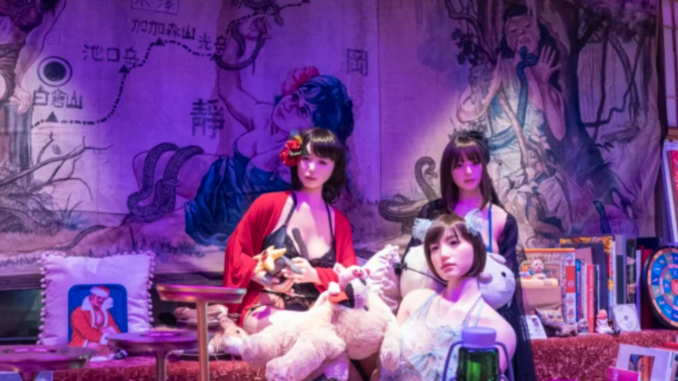
And then there’s the one keeping the spirit alive in Tokyo: the Museum of Roadside Art in Mukōjima, Sumida Ward. Photographer and editor Tsuzuki Kyōichi salvaged the mannequins and sets from the old Toba SF Miraikan — the one that mixed sex with a “erotic space future journey” theme — and installed them in a former ryōtei in an actual old geisha neighborhood. Tokyo Skytree is visible from the roof.
It’s not a dusty museum. There’s a bar on the second floor sitting among the love dolls. They do the occasional rakugo night. The curator’s whole point is that this stuff is culture, not something to be embarrassed about. He once hung the Bread and Puppet Theater’s “Why Cheap Art?” manifesto over the door.
Foreign visitors make up a big chunk of the crowd now. Japanese people walk in with a filter already on: “Ah yes, that ridiculous Showa thing.” People from overseas just go, “Wait, what?”
If you want to go
The Tokyo spot is in Mukōjima, a short walk from Hikifune Station. Evenings only, 18+, ¥3,000 including a drink voucher for the bar (there’s a cheaper weekday look-only ticket). Closed Sundays and holidays.
It’s one of the last places where you can still walk through the exact flavor of kitsch that used to wait for salarymen at the end of a highway off-ramp. Most of the others are just stories and a pile of mannequins in storage.